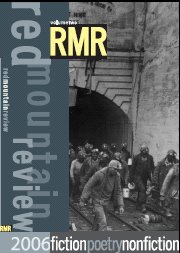
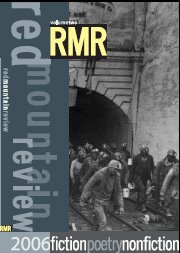
Recently, we received an e-mail from a frantic MFA student who had a big-time bee in his bonnet to get his hands on a copy of RMR. Seems he'd been assigned one of those mind-numbing reports for his poetry workshop. His mission: Drone about chapbook contests -- particularly those which feature the winner embedded in a literary magazine. At least that's what he told us. Could be he was a spy for the government.
At any rate, since we're no strangers to all things half-assed and last-minute, we obliged the poor guy. No charge, even -- but there was a catch. He had to disseminate the following screed to any and all who would listen. Did he do it? You'll have to ask the folks in State College, PA. But just in case you don't get to Happy Valley any time soon, here it is, in its glorious entirety (albeit slightly edited for readability)...
A SEMI-MINI-MANIFESTO
One thing of note on chapbook contests: Ours is free to enter. It's one of the only such contests (free entry, that is) I know about.
I mention that because I think it's worthwhile for us writers and editors to consider the repercussions of the "pay-to-play" publication model, which has a stranglehold on contemporary poetry in particular. Book contests, first-book contests, chapbook contests -- now lit mags are increasingly sponsoring contests for individual poems, stories, or essays. One could easily spend hundreds of dollars a year in pursuit of a "win" in one of the Big Fish contests -- even more than that if a little fish will do. To what end, though? To be read? Or -- more likely, I fear -- for a noteworthy line on a vita?
I certainly don't have a magic solution to the problem, but I think it's insidious and important. What does it say about us writers of contemporary literature? How much will we shell out in an effort to be published before we realize that we're just so many Wile E. Coyotes running madly in thin air?
I also wonder what it says about us as (non)readers of contemporary literature. If small presses and magazines can't support themselves through subscriptions and sales -- if we have far more submissions than we do subscriptions, and we do -- what exactly are we up to here? Almost by definition, that means more people are writing than reading. Why? And what, then, is the role for the contemporary literary magazine in such a landscape?
The Faux-Capitalist approach -- market-driven business plans aimed at increasing readership, for instance -- is just that: faux. Why? Because the real market isn't readers, it's writers.
Readers don't value us nearly as much as writers do. That's a fact. (Feel free to banty about the chicken-or-egg question of what's a reader, what's a writer, and where they intersect. To me, writing is best served if it aspires past onanism [i.e., writing for other writers], but that might just be me. PS...Raise your hand if the first place you look in a lit mag is the contributors section.)
Case in point: When I edited Black Warrior Review -- one of the older, more reputable lit mags around -- guess how many subscribers we had. About 350, give or take. Just under $5,000 gross income per year. We got that many submissions (350) in a month -- often more. With a yearly budget of around $20,000, my successors at the moderately cash-strapped BWR have recently instituted a wildly successful pay-to-play fiction contest, whereby the winner gets $1000 and his/her winning story published in the magazine. It grossed $9,000 last year. Can you blame them? Clearly, from a strictly quantitative perspective, that's a market to mine. In our system, publication is worth more to the writer than it is to the reader.
But do we realize there's some troubling morality at play in that equation? At best, it's built on circular logic: there aren't enough readers who want to buy all this writing so we're going to sell it back to the writers, who can then show university hiring committees that, indeed, they are significant enough writers to serve on a faculty that is charged with...creating more writers. Or at least they can teach the service courses the creative writing and literature faculty doesn't want to teach. (Don't look now, but isn't that us dropping towards the canyon floor faster than an ACME anvil?)
I say we, as lit mags, need to redefine our purpose. We should aim to serve, not solicit, writers. Why serve writers -- why embrace them as a constituency?
Because, damn it, they -- we -- need it and nobody else is going to do it but us. Because lit mags and small presses aren't mini-corporations; they're activist organizations. Because writers still have an important role in the body politic: to keep our culture evolving, to encourage good, provocative thought, and to inspire action -- directly or indirectly--based upon that enlightened thought.
Therefore, a lit mag's goal should be to publish and distribute work that would not otherwise see the light of day. To provoke thought. To provide an energetic, active, tangible space for said endeavors. And to do it in the most writer-friendly way possible. Free contests, openness to simultaneous submissions, and quick turnaround times are a few tangible ways to be writer friendly. [EDITOR'S NOTE: Please stay tuned to this space for another mailbag where folks rail against us for our own shortcomings in this regard. It's like the Dalai Lama says--we never said all this moralizing and compassion was easy. Necessary, yes. Easy, no.]
We need to rethink distribution and funding as well. Is Ingram's anonymous, hands-off distribution model the right one to aspire to? And practically speaking, does it even matter if it is -- few lit mags can count themselves "lucky" enough to be taken into the Ingram fold.
I think our lit mags and small presses need to "think global, act local." Or hell, think local, act local. Every community has writers in it. Writers make a community richer, smarter, more thoughtful, more empathetic, more introspective. A lit mag can -- and should -- be a local nexus for the literary arts. One that both provides a supportive common environment for literary artists but that also stakes its ground within the larger community. Poets in the schools. Public readings. Community workshops. Reading groups...
How do you pay for it? Ask for money from people who actually have it. Write grant proposals. Get shrewd about in-kind services. Publish fewer issues, smaller issues, use the web to complement content as well as to augment sales & distribution.
Clearly I'm getting carried away in a Utopian fervor. And I'm not really sure what this has to do with chapbook contests -- other than maybe this bit of advice for you and your peers: Beware the literary-industrial complex! I'll go back to my padded room now...
1.03.2007
MAILBAG: THE MORALITY OF PAY-TO-PLAY?

12.20.2006
SEND US STUFF!
 ● poems
● fictions
● nonfictions
● chapbooks
ander monson ● bruce smith ● joan connor ● jim daniels ● katherine soniat ● charles jensen ● lou suarez ● rane arroyo ● tony crunk ● janet mccann ● john pursley iii ● emily rapp ● kelli russell agodon ● diane glancy ● josh russell ● mark neely ● chris forhan ● alison pelegrin ● kat meads ● angela balcita ● kristine somerville ● elizabeth rees ● you?!?!?!?!?!?!?!?!.....
be sure to include the title and the genre in the subject line, such as: "Moby Dick (fiction)"; "Five Poems"; "The Wasteland (chapbook)"; etc. if you want to be extra safe, send the text of your manuscript in the body of the e-mail as well.
We're reading for RMR3 from now through April 2007!
10.29.2006
RMR2, ROUGH BEAST, SLOUCHES TOWARD BETHLEHEM
 We are still here.
The media empire that is RMR continues its inexorable pursuit of total market dominence. Today, central Alabama. Tomorrow the world!
Lots going on in the last two months:
RMR2 is back from the printer and ready for purchase! New work from Joan Connor, Rane Arroyo, Diane Glancy, Jim Daniels, Janet McCann, and lots of others, "emerging and established," as the saying goes.
Just send us a check or money order for $6 to RMR/ASFA Foundation, 1800 8th Ave N, Bham, AL 35203. Or better yet, buy us right here on-line (see above and to the right)!
Poet Jim Murphy has agreed to come aboard as Poetry Co-Editor, joining the inimitable Mary Kaiser. This stokes us.
Last but not least, we've completed a deal with absnth.com to produce a stand-alone limited edition version of our chapbook each year! That means you can get Lou Suarez's On U.S. 6 to Providence (see above left) all by its lonesome for just $4. Buy it here on-line today! Here's a little teaser...titular, no less!
On U.S. 6 to Providence
Today I am lonely. It is not
the loneliness of a city without a river,
the waters on which the new ducks
enter, stay, then leave, on which
boys skip rocks and into which
girls wade knee-deep. Nor is it
the loneliness of the Confederate soldier,
so statuesque in the town square.
The pigeons at least flock to him
or splotch his head and shoes with white
that becomes black and hardens in sun.
And it is surely not the loneliness
of the bare tree in a field. No, not like that,
and not the tire in a roadside ditch,
not the fire escape
behind a school, the school itself.
I have never studied loneliness,
do not know how it resembles, say, love
or glory, nor how it differs from solitude, thirst.
I know this much: each has its own
rhythms that, when played together, make
a syncopated music I hear
in a part of my brain not meant for hearing.
I hear it in human breathing, hear it
in the truck driver's voice and hunch,
the bed wetter's, the asthmatic's....
Want the rest of the poem--and sixteen others as contemplative and wise? Buy it here! Now!
8.15.2006
YOU LOVE UTNE, WE LOVE UTNE, AND UTNE LOVES...
...well, Angela Balcita, but so do we, so it's all, like, one big happy love triangle! (Heck, throw Elysian Fields Quarterly in there, and we've got a rhombus! Or wait...would that be a pentagon?)
Anyhoo, check out this month's Utne for a reprint of the creative nonfiction piece formerly known as "You, Too, Can Be Americano" -- now simply "The Americano Dream" -- which first appeared in RMR1.
7.17.2006
WANT TO DESIGN AND PRINT YOUR OWN FANCY LIT MAG?
You know you do. If not you, who? If not now, when? Dammit, ask not what your country can do for you...
And when you finally decide to take the plunge, talk to Russell at www.absnth.com.
RMR is pleased to announce that absnth, inc., will be at the reins of the Quark Xpress (or whatever the heck program they use these days) for issue 2. Couldn't be in better hands, as Russell and the crew also handle the award-winning PMS: Poem-Memoir-Story.
Check 'em out.
7.04.2006
CHECK OUT OUR NEWPAGES.COM REVIEW!
We're "unapologetically, if subtly, political"!
We're a "tender pinata"!
(That's good, right?!)
Read the review in toto [scroll down], cuz baby we ain't in Kansas anymore! In the words of the collective prophet, ZZ Top, we're nationwide!
So quit your elbowing -- there's plenty of Pez candy and trinkets for everybody...
3.13.2006
AWP-AUSTIN REFLECTION: 'EDGY' IS THE NEW 'FLOW'
His dark hair was longish and mussed, and his t-shirt was black. He was handsome in the way that many young men these days are trying to be: that is to say, scruffy, slightly off-kilter, shabby-chic. Like dozens of other editors and assorted hangers-on in the Austin Convention Center last week, the young man in question was hawking a literary magazine -- one he and his compatriots are looking to revive in a fresh new image. Asked just what kind of work he thought would do the trick, the E-word jumped off his lips.
'Edgy.'
In the end, what other word could he have used? To not use it would have been an affront to his milieu. After all, it isn't just us AWPeons who are scrambling for edges and ledges to toe. It's everywhere: cheerleaders pierce their tummies, grandmas get tattoos, politicians cap their boyz in the face. Rumor has it, they just made a movie where pretty men do a bunch of making out. With each other.
But we here at RMR can't help but feel a little deja vu all over again. For a while we couldn't figure out what the Ubiquity of 'Edgy' reminded us of and then it hit us: It's just like in countless writing classrooms, creative or otherwise, when students try to describe what they like or don't like about a piece of writing.
"It 'flows,'" they say, often with great self-assurance, as if it is the kind of empirical statement that cannot possibly be assailed. 2 + 2 = 'Flow.' And 'flow' is good.
But, alas, 'flow' is a word that, in the context of writing, doesn't mean anything in particular. Oh, it approximates meaning (we know, we know: that's all language ever does, blah, blah, blah). 'Flow' sort of means that 1) the poem or story proceeds in a linear -- oft narrative -- fashion, 2) the language is rhythmical, 3) the reader lost herself in the story or poem's occasion, 4) the reader did not have to stop reading to think about a word or phrase or concept, whether or not the writer intended it, 5) all of the above, 6) two or more, but not all, of the above, or 7) something else entirely.
Isn't that what 'edgy' is these days, especially in the context of the literary magazine's project? A word that means a lot of things to a lot of people, and therefore means exactly nothing to no one? Besides, aren't all literary magazines, stationed as we are on the Tatooine of contemporary culture (could be worse -- at least they gave us not one but two suns!), on the edge of something by default? Solvency? Sanity? Irrelevancy?
We raise the point not to throw a wet blanket on the many, many editors represented at AWP-Austin (not least ours truly at table #628) who want to publish work that gets a rise out of somebody -- anybody. Good. May the Force be with us. But we have to remember our audience. It's small. It consists largely of writers, many of whom are odd by birth, instinct, and experience. Put simply, it's always been daggone hard to get much of a rise out of us.
Couple that with the kinds of sugar-spike rises that make the developed world go round -- TV shows where people eat bugs and spleens; housing bubbles; big, fat Starbucks venti Sumatras -- and 'the edge' just ain't where it used to be. More than not these days, it's right smack dab in the middle of the road.
So here's our two cents:
If everybody's doing it -- whether 'it' is gender-bending, genre-bending, or just bending whichever way the wind blows -- then 'edgy' isn't edgy enough. We have to ask for more. More important, we have to know what it is we're asking for.
Shock and decadence (in all its forms) are easy. 'Original' is overrated. At RMR we're going to keep asking for 'interesting,' 'intelligent,' with a healthy measure of plain-old 'observant.' That's plenty enough to upset most applecarts anyway.
2.22.2005
ALL ABOUT RED MOUNTAIN REVIEW
Red Mountain Review takes its name from the seam of iron ore that runs through the heart of central Alabama. The magazine is produced at the Alabama School of Fine Arts, with the support of the Alabama State Council on the Arts, Southern Progress Corporation, and the creative writing faculty at Jefferson State Community College and the University of Montevallo. In partnership with the Red Mountain Reading Series--which has hosted such writers as Dana Johnson, Peter Meinke, Tom Franklin, Natasha Trethewey, and many more--RMR is poised to take its place in Alabama’s long tradition of helping America’s best writers of poetry, fiction, and creative nonfiction find an audience.
We have a simple goal—to produce a fine literary magazine that gets noticed, and to do so with Birmingham’s roots in mind. The Magic City has a long history of working hard and of grappling with hard truths. We will, therefore, always seek to recognize those in our field who do the hard work, who tell the hard truths, and who do so expecting little or no remuneration. Which is to say, the vast majority of writers of contemporary literature, literature that—for reasons of form, length, subject, or project—has traditionally had a difficult time finding the light of day in mainstream commercial venues. Luckily, our editorial tastes are broad: academics and “real people;” sonneteers and the so-called “Grrl-esque” poets; writers of very short nonfiction; those who write long, leisurely, expansive fiction. The list goes on.
In addition to publishing great individual poems, stories, and essays, we are the champions of the chapbook. Every issue will feature the winning collection from our chapbook contest, which is free to enter and is judged independently by a poet of national reputation. The contest winner recieves a $250 honorarium and publication in the magazine.
Thanks for your interest in RMR and in contemporary writing in general. Please peruse the rest of this site to see more about what we’re up to. And you might as well bookmark us, because we'll have a steady stream of contest announcements and updates, book reviews, links, and other fun tidbits.
Contact the editors at RMRsubmissions@gmail.com.